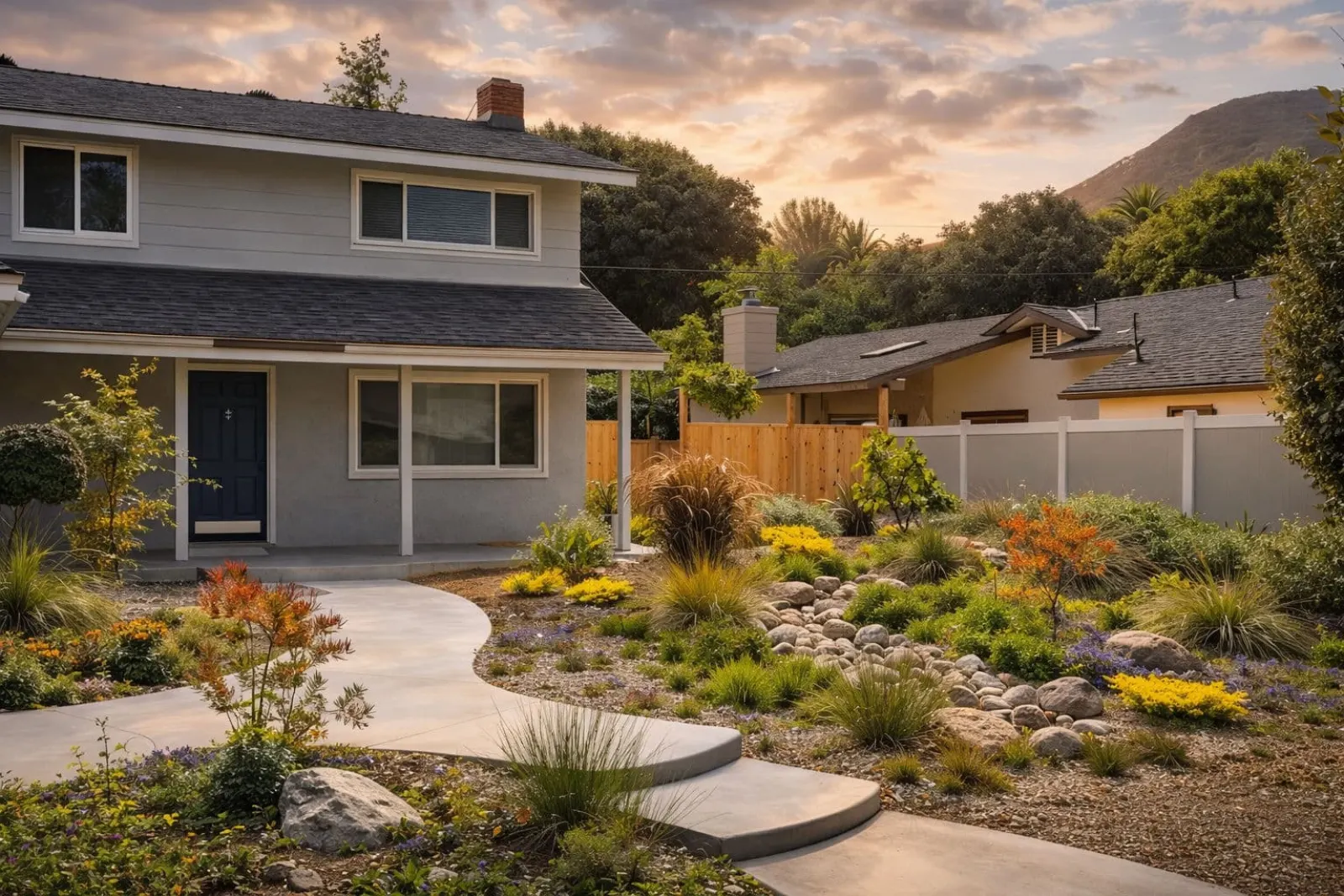
Whole-Property Landscape Design
What a 3D model settles
Changes on screen cost an afternoon. The same change after a footing is poured costs a demolition.
A landscape is the most expensive thing most households build without ever seeing it first. A to-scale model of the actual property settles the decisions that are ruinous to change later: the levels, the layout, the materials and the sight lines, all of them argued out on screen while changing them is nearly free.
It settles arguments between two people who both live there
A plan view is read differently by different people, and two people looking at the same drawing frequently agree while picturing different gardens. A walkthrough does not allow that, which is why the disagreement happens at design stage instead of at the pour.
It shows planting at two moments in time
The gap between a five-gallon shrub on planting day and the same shrub in four years is the difference between a scheme that reads sparse and one that has become unwalkable. Showing both is the single most useful thing a model does for a garden.
It makes the estimate mean something
A price against a defined design is a price that holds. A price against an intention is a number that moves, and that is where most of the unpleasant stories in this trade come from.
What it does not do
A model is not a survey, a soils report or a structural engineer. It will not say what is buried under the yard, it does not replace a geotechnical opinion on a slope, and it cannot promise a permit outcome. It is a design instrument and it should be honest about its edges.
Questions people actually ask
Do we have to build with you to get the model?
No. The design is its own piece of work and it is yours. Most people go on to build with us; some take the model, live with it for a season and come back later.
How accurate is it?
Layout, levels and materials are accurate because they are built from measurements of your lot. Planting is shown at a stated size and at maturity, which is two honest moments rather than one flattering one.
How many rounds of changes are normal?
Several, and that is the point. Changing your mind on screen is the cheapest thing you will do on the entire project.
The rest of the guide
Whole-Property Landscape Design, one question per page.
- Whole-Property Landscape Design: the complete guideThe hub page: what it is, the sequence, and what one company changes.
- The order of the workNot a scheduling preference. Every stage decides where water goes for the one after it.
- Four contractors, and the seamsThe normal way a property gets built, and the specific places it comes apart.
- Services before concreteThe cheapest decisions on the whole project, and the ones most often skipped.
- Drainage decides everythingThe unglamorous half of the budget, and the half that is still right in ten years.
- The pool inside the planThe shell is rarely the problem. Where it sits almost always is.
- Phasing a whole propertyAlmost nobody does it all at once. Doing it in the right order is what makes that cheap instead of expensive.
- One scope, one priceSix quotes for one property are usually six different projects, which is why they cannot be compared.
- The handoverA landscape is a system somebody has to run after we leave. Being told how is part of the work.
- Where this falls shortThe page most companies in our position do not write.
Tell us about the property
Send a few lines about what you have and what you want. We will tell you what we think it takes, what order it should happen in, and whether we are the right company for it.