Fire-Resilient Landscape Design
Hardscape as a firebreak: where stone earns its keep
A path is not automatically a firebreak. Width, continuity and what sits either side of it decide whether it does anything at all.
Hardscape is one of the most effective tools in fire-resilient landscape design, because a non-combustible surface carries no fuel. It is also the tool most often installed in a way that does nothing: a decorative path winding through continuous planting interrupts nothing, because fire goes around it.
What makes a hard surface useful
A hard surface does structural work when it is continuous, wide enough that flame and radiant heat do not simply cross it, and positioned where it separates one body of fuel from another or from the house. A driveway that runs the width of the property does more than any planting scheme. A stepping-stone path through a shrub bed does nothing.
This is why the first five feet around a structure is so often paved, graveled or set in decomposed granite. It is the shortest possible firebreak in the most valuable possible position.
Walls, terraces and the shape of the ground
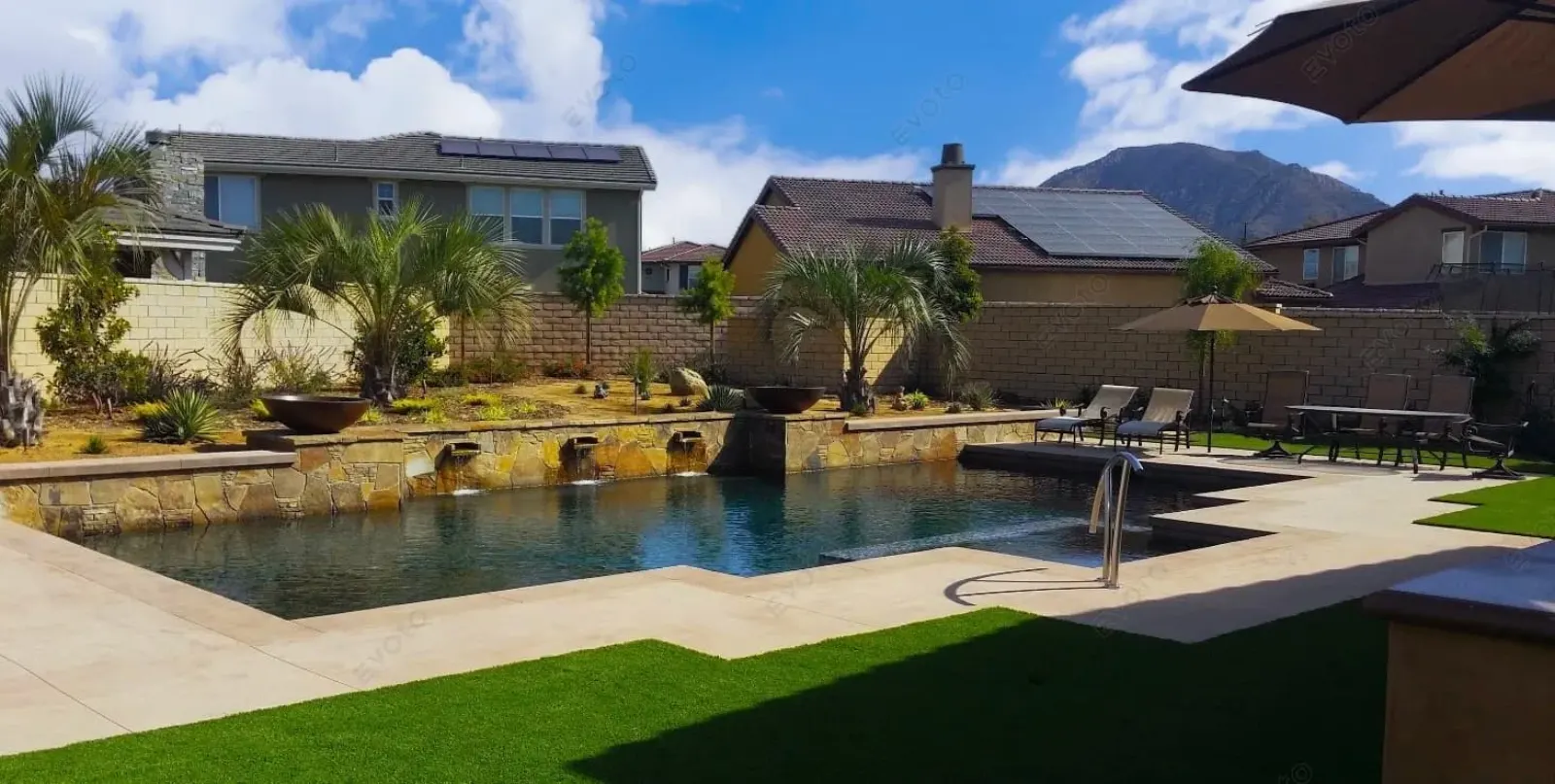
Retaining walls and terraces change fire behavior on a slope by breaking a continuous face into steps, and each step is an opportunity for a non-combustible band. On the hillside lots common in Calabasas, Malibu and Agoura Hills, this is where hardscape and fire resilience become the same piece of work rather than two competing budgets.
Masonry also solves the fence problem: replacing the last section of a combustible fence where it meets the house with masonry or metal removes a direct fuel path to the building.
Where gravel is doing less than it appears to
Gravel over weed fabric with no maintenance becomes a gravel-coloured bed of dry organic litter within about two years. It looks like a firebreak in a photograph and behaves like a fuel bed in September. Any non-combustible surface that collects leaf litter needs to be cleared, and that maintenance requirement should be stated when it is sold, not discovered later.
Questions people actually ask
How wide does a hard surface have to be to matter?
Wide enough that fuel on one side is genuinely separated from fuel on the other, and the honest answer depends on slope, wind exposure and what is growing either side. A driveway-width surface does real work; a two-foot path through continuous planting does not.
Is gravel better than paving?
For fire behavior both are non-combustible, so the difference is maintenance and drainage. Gravel collects litter and needs clearing to keep working. Paving sheds it, costs more, and changes where water goes, which then has to be designed for.
Will a masonry wall protect the house?
A wall can interrupt a fuel path and block some radiant heat. It cannot stop embers, which arrive by air and are the main way houses are lost. Treat hardscape as one layer among several, never as the answer.
Sources
Sources: CAL FIRE, Defensible Space, Los Angeles County Fire Department. Requirements change and vary by address. Confirm yours with your local fire authority before relying on anything here.
The rest of the guide
Fire-resilient landscape design, one question per page.
- Fire-Resilient Landscape Design: the complete guideThe hub page: what it is, the zones, and what it changes on a property.
- Zone 0: the first five feetThe smallest zone, the one that costs a garden the most, and the one nearly everybody gets wrong.
- Plant selection and spacingThere is no fireproof plant. There are plants that are badly placed, badly spaced and badly maintained, and those are the ones that carry fire.
- Irrigation and fuel moistureThe moisture in a living plant in September is a design outcome, decided by a controller somebody set in July.
- Slopes and hillside lotsA house above a slope has a different problem from a house on flat ground, and the same clearance distance does not mean the same thing.
- Insurance and HOA inspectionsWe can build a landscape that meets what an inspection asks for. We cannot promise you a policy, and anybody who does is not in a position to.
- The maintenance calendarEverything built on the rest of this site stops working within two seasons if nobody clears it.
- Rebuilding after a fireThe ground is not the ground it was. Putting the old garden back on it is how the second problem starts.
- Cost and sequencingAlmost nobody does the whole property in one go. The order you do it in changes how much protection you have bought at every point along the way.
- Rebuilding in Malibu and the canyonsWhat the ground needs before anything is planted, and why the garden is the last stage rather than the first.
- Where this falls shortThis is the page most companies in our position do not write. It is here because the alternative is letting somebody believe a garden will save a house.
Tell us about the property
Send a few lines about what you have and what you want. We will tell you what we think it takes, what order it should happen in, and whether we are the right company for it.