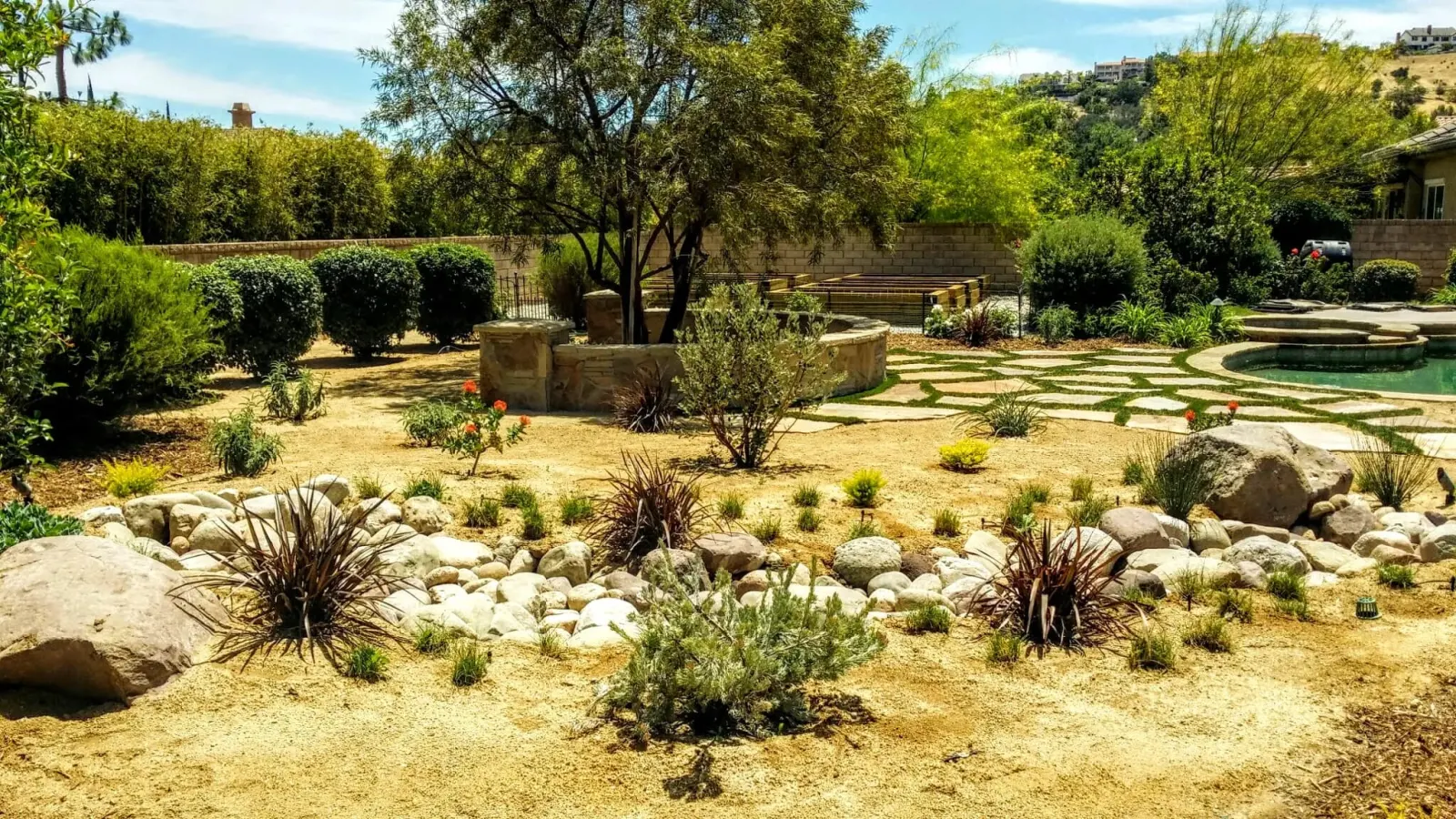
Fire-Resilient Landscape Design
Where fire-resilient landscape design falls short
This is the page most companies in our position do not write. It is here because the alternative is letting somebody believe a garden will save a house.
Fire-resilient landscape design reduces the ways a fire can reach a building and lowers the intensity of what arrives. It does not make a house safe, it is not the most important thing you can do to a property, and there are several situations where it will not be enough. All of that is true, and we would rather say it than have somebody find out.
The building matters more than the garden
The evidence consistently points at the structure itself: the roof, the vents, the eaves, the windows and the deck. Embers entering an attic vent or igniting a wooden deck is a more common path to losing a house than fire arriving through the planting. If you have one budget and have to choose, hardening the building generally buys more than landscaping does.
We are a landscape company saying that, and we say it because the opposite framing sells more of what we do.
Extreme conditions overwhelm all of it
Under high wind, single-digit humidity and a large ember cast, well-prepared properties are lost. Defensible space is also partly about giving firefighters a place they can safely work, and in a fast wind-driven event crews may not be there at all. A landscape plan is a probability change, not a guarantee, and anybody presenting it as more than that is misrepresenting it.
It degrades quietly
The condition this work produces decays without maintenance, and it decays invisibly: a property can look much as it did on the day it was finished while the first five feet slowly refills with litter and the shrubs slowly fill with dead wood. A landscape that was correct three summers ago tells you nothing about this summer.
It costs a garden something real
Zone 0 removes the planting people most enjoy, which is the planting up against the house. Spacing requirements make certain dense, romantic, enclosed garden styles impossible. Some of the most beautiful plants for our climate are poor choices near a structure. There is a genuine loss here, and pretending there is not is how people end up disappointed with work that was correctly done.
What fire-resilient landscape design does do
Fire-resilient landscape design removes the easy ignition paths, it slows and lowers what arrives, it gives crews somewhere to work, it is often what an insurer or association is asking for, and it makes a property demonstrably maintained rather than demonstrably neglected. Those are worth buying. They are not the same as safety, and we will not describe them that way.
Questions people actually ask
So is fire-resilient landscaping worth doing?
Yes. Fire-resilient landscaping is worth doing and it is not sufficient on its own. It removes the most common ignition paths and lowers the intensity of what reaches a building, which is a real and measurable improvement. It does not make a house safe, and hardening the structure itself generally buys more per dollar.
What should I do first if I can only do one thing?
Clear and keep clear the first five feet around the structure, and look at your vents, roof and deck. Between a landscape budget and a building-hardening budget, the building usually wins.
Why would a landscape company tell me this?
Because the alternative is a client who believes a garden will save a house. We would rather be the company that told you the truth and got a smaller job than the one that sold you certainty it could not provide.
Sources
Sources: CAL FIRE, Defensible Space, California Office of the State Fire Marshal, Fire Hazard Severity Zones, Los Angeles County Fire Department. Requirements change and vary by address. Confirm yours with your local fire authority before relying on anything here.
The rest of the guide
Fire-resilient landscape design, one question per page.
- Fire-Resilient Landscape Design: the complete guideThe hub page: what it is, the zones, and what it changes on a property.
- Zone 0: the first five feetThe smallest zone, the one that costs a garden the most, and the one nearly everybody gets wrong.
- Plant selection and spacingThere is no fireproof plant. There are plants that are badly placed, badly spaced and badly maintained, and those are the ones that carry fire.
- Hardscape as a firebreakA path is not automatically a firebreak. Width, continuity and what sits either side of it decide whether it does anything at all.
- Irrigation and fuel moistureThe moisture in a living plant in September is a design outcome, decided by a controller somebody set in July.
- Slopes and hillside lotsA house above a slope has a different problem from a house on flat ground, and the same clearance distance does not mean the same thing.
- Insurance and HOA inspectionsWe can build a landscape that meets what an inspection asks for. We cannot promise you a policy, and anybody who does is not in a position to.
- The maintenance calendarEverything built on the rest of this site stops working within two seasons if nobody clears it.
- Rebuilding after a fireThe ground is not the ground it was. Putting the old garden back on it is how the second problem starts.
- Cost and sequencingAlmost nobody does the whole property in one go. The order you do it in changes how much protection you have bought at every point along the way.
- Rebuilding in Malibu and the canyonsWhat the ground needs before anything is planted, and why the garden is the last stage rather than the first.
Tell us about the property
Send a few lines about what you have and what you want. We will tell you what we think it takes, what order it should happen in, and whether we are the right company for it.