Fire-Resilient Landscape Design
Plant selection and spacing: why the list matters less than you think
There is no fireproof plant. There are plants that are badly placed, badly spaced and badly maintained, and those are the ones that carry fire.
In fire-resilient landscape design, plant selection matters, but spacing, moisture content and maintenance matter more. A well-watered, well-pruned shrub of a supposedly flammable species standing alone is a smaller problem than a drought-stressed, dead-wood-filled specimen from a fire-resistant plant list packed into a hedge.
Fire travels between plants, so the gaps are the design
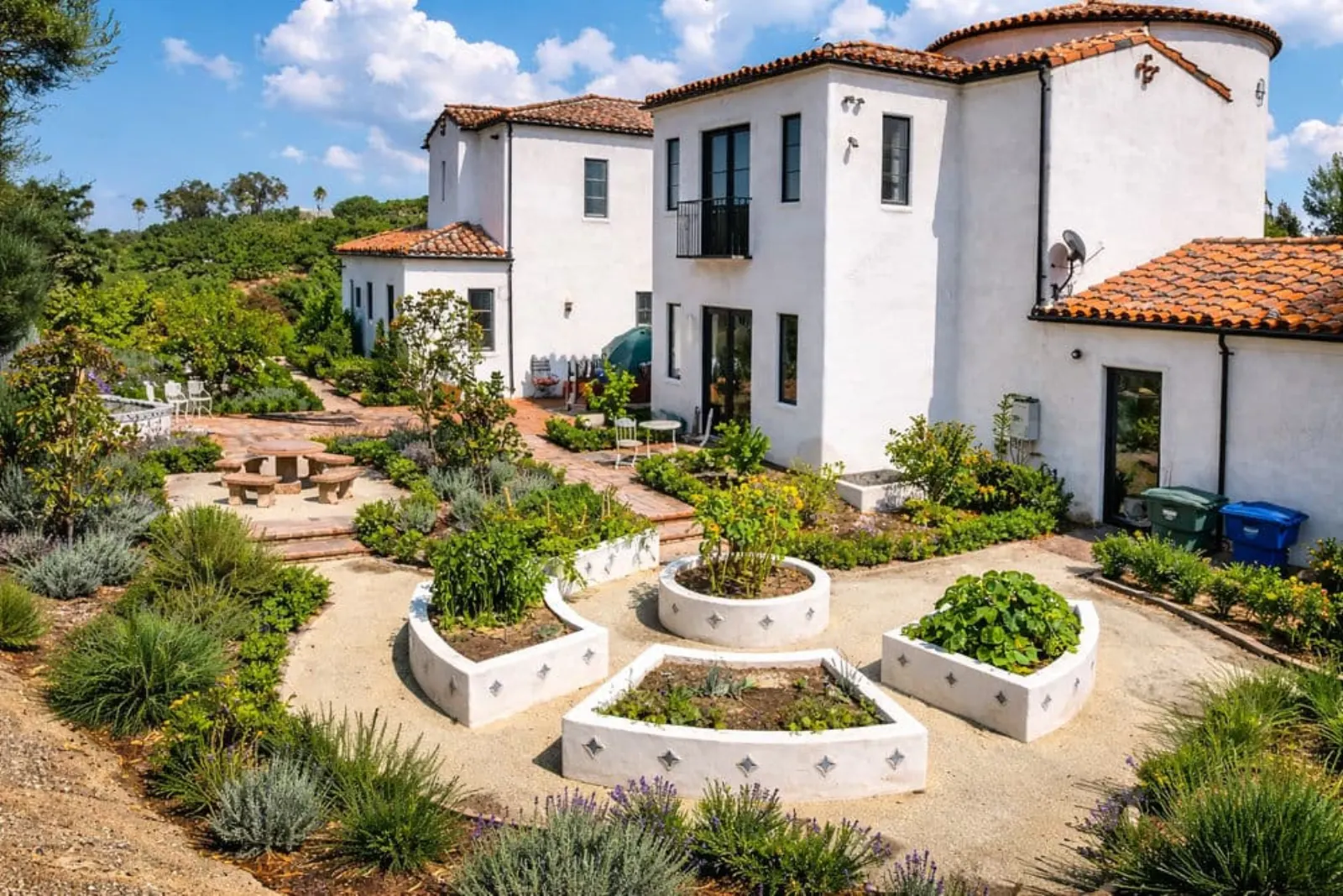
A continuous mass of planting is a continuous fuel path. Breaking it into islands with real gaps between them, both horizontally across the ground and vertically between low planting and tree canopy, is the mechanism that stops a ground fire climbing into the trees and then into the roof line.
This is why a fire-resilient garden often looks more considered than a conventional one. The spacing is doing structural work, and once you know to look for it you can see the intention.
What actually makes a plant a liability
Three properties matter more than species: how much dead material it holds, how much moisture it carries through late summer, and how much volatile oil is in the foliage. A plant that accumulates dead thatch inside itself is carrying its own kindling, and several of the most common Southern California ornamentals do exactly that.
This is also why maintenance is not a separate topic. The same plant is a different risk in September than it was in May, and the difference is entirely down to whether somebody cleared it.
Native does not automatically mean safe
Chaparral is native and it is built to burn: that is its reproductive strategy. Choosing California natives is good practice for water use, soil and habitat, and it is not by itself a fire strategy. The two goals overlap in places and diverge in others, and a designer who pretends they are the same thing is selling one and calling it the other.
Trees near the house
Mature trees are the hardest conversation on a fire-resilient property, because they are the most valuable thing in the landscape and the most consequential if they are in the wrong place. The usual work is not removal, it is limbing up to break the ladder from ground fuel into canopy, clearing dead wood, and keeping canopy off the roof and away from the chimney. In Thousand Oaks and Agoura Hills the oaks are also legally protected, so the pruning plan and the fire plan have to be the same plan.
Questions people actually ask
Is there a list of fireproof plants?
No. There are lists of plants that ignite less readily under test conditions, and they are useful, but no plant is fireproof and a stressed, unmaintained specimen from any list will burn. Spacing, irrigation and maintenance change the outcome more than swapping one species for another.
Do I have to remove my oaks?
Almost never, and in Thousand Oaks, Agoura Hills and much of the Conejo Valley they are protected anyway. The usual work is clearing the fuel underneath, breaking the ladder from ground level into the canopy, and keeping limbs off the roof.
Does succulent planting solve this?
Succulents carry high moisture and are a genuinely useful tool near structures. They are not a whole strategy: they still need spacing, they still collect dead leaves underneath, and a large succulent bed with no maintenance still accumulates litter that will carry fire.
Sources
Sources: CAL FIRE, Defensible Space, Ventura County Fire Department. Requirements change and vary by address. Confirm yours with your local fire authority before relying on anything here.
The rest of the guide
Fire-resilient landscape design, one question per page.
- Fire-Resilient Landscape Design: the complete guideThe hub page: what it is, the zones, and what it changes on a property.
- Zone 0: the first five feetThe smallest zone, the one that costs a garden the most, and the one nearly everybody gets wrong.
- Hardscape as a firebreakA path is not automatically a firebreak. Width, continuity and what sits either side of it decide whether it does anything at all.
- Irrigation and fuel moistureThe moisture in a living plant in September is a design outcome, decided by a controller somebody set in July.
- Slopes and hillside lotsA house above a slope has a different problem from a house on flat ground, and the same clearance distance does not mean the same thing.
- Insurance and HOA inspectionsWe can build a landscape that meets what an inspection asks for. We cannot promise you a policy, and anybody who does is not in a position to.
- The maintenance calendarEverything built on the rest of this site stops working within two seasons if nobody clears it.
- Rebuilding after a fireThe ground is not the ground it was. Putting the old garden back on it is how the second problem starts.
- Cost and sequencingAlmost nobody does the whole property in one go. The order you do it in changes how much protection you have bought at every point along the way.
- Rebuilding in Malibu and the canyonsWhat the ground needs before anything is planted, and why the garden is the last stage rather than the first.
- Where this falls shortThis is the page most companies in our position do not write. It is here because the alternative is letting somebody believe a garden will save a house.
Tell us about the property
Send a few lines about what you have and what you want. We will tell you what we think it takes, what order it should happen in, and whether we are the right company for it.