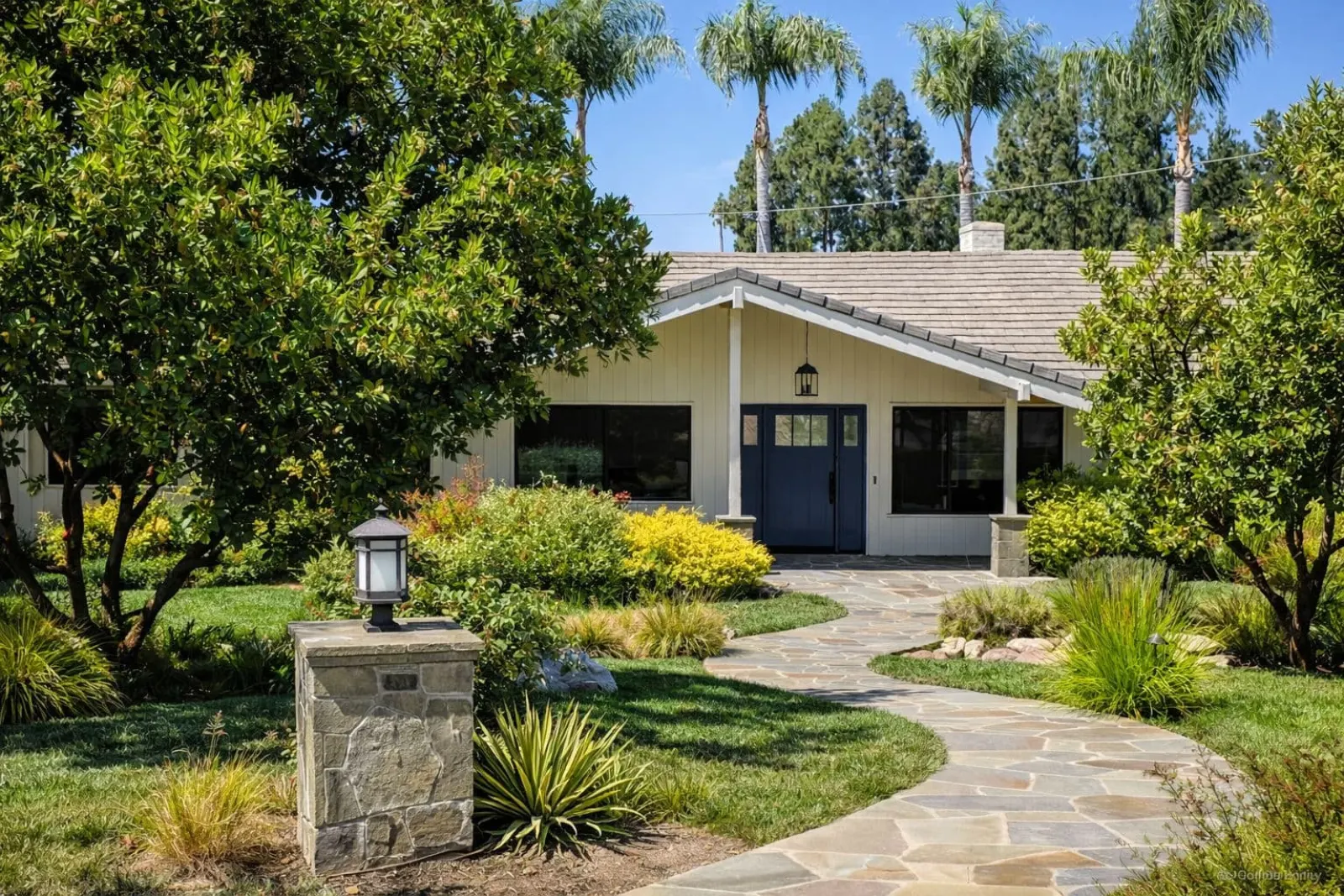
Fire-Resilient Landscape Design
Zone 0: the first five feet around the house
The smallest zone, the one that costs a garden the most, and the one nearly everybody gets wrong.
Zone 0 is the ember-resistant zone: the ground within about five feet of a structure. In fire-resilient landscape design it is the single highest-value area to get right, because most homes that are lost in a wildfire are not consumed by a wall of flame arriving through the garden. They are ignited by embers landing in something combustible up against the building, hours before or after the front passes.
What lives in Zone 0 and what does not
The design intention in Zone 0 is that there is nothing within five feet of the wall that an ember can start. That means no bark mulch, no dry ornamental grasses, no woody shrub pressed against the siding, no firewood stack, no plastic pots, and nothing stored under the deck. It usually also means moving the pretty foundation planting that most Southern California houses were sold with.
What can be there: paving, gravel or decomposed granite, stone, bare irrigated soil, and low, well-watered, well-maintained groundcover where local rules allow it. The effect people fear is a moat of gravel. The effect a good design achieves is a clean architectural band that reads as intentional, with the planting starting just beyond it.
Why this zone is treated differently from the rest
California added the ember-resistant zone concept through AB 3074 in 2020, on top of the existing defensible space requirement, precisely because the first five feet behaves differently from the rest of the property. Beyond the house, the aim is to slow and lower a fire. Against the house, the aim is that nothing ignites at all.
It is worth being clear about the trade: this is the zone where fire-resilient landscape design costs you the most in ordinary garden pleasure. There is no version of it where a climbing rose on the wall survives the review.
The details that get missed
Vents, the gap under a deck, and the point where a wooden fence meets the house are the three places we most often find a good Zone 0 undone. A fence is a fuse: a combustible fence running into a wall delivers fire to the building even when the ground around it is immaculate. The usual fix is a non-combustible section, typically masonry or metal, for the last few feet before the structure.
Gates, trellises, planters and pergolas attached to the building are all part of the same question, and they are all things a landscape contractor installs.
Questions people actually ask
Does Zone 0 mean I cannot have any plants near the house?
Zone 0 means nothing combustible within about five feet of the wall, which rules out woody shrubs and bark mulch against the house. Low, irrigated, well-maintained groundcover is treated differently from a dry shrub, and local rules vary, so the workable answer for your address comes from your fire authority rather than from a general article.
Is bark mulch really a problem?
Against a wall, yes. Bark and shredded wood mulch hold embers and smoulder, which is the exact ignition path Zone 0 exists to remove. Beyond the first five feet mulch is a normal and useful part of a garden, including for the moisture retention that helps everything else.
Do I have to rip out planting that is already there?
Not necessarily all at once. Zone 0 is usually the first phase of a staged plan because it is small, it is the highest-value area, and it can be done without redesigning the rest of the property.
Sources
Sources: CAL FIRE, Defensible Space, California Public Resources Code section 4291, California Office of the State Fire Marshal, Fire Hazard Severity Zones. Requirements change and vary by address. Confirm yours with your local fire authority before relying on anything here.
The rest of the guide
Fire-resilient landscape design, one question per page.
- Fire-Resilient Landscape Design: the complete guideThe hub page: what it is, the zones, and what it changes on a property.
- Plant selection and spacingThere is no fireproof plant. There are plants that are badly placed, badly spaced and badly maintained, and those are the ones that carry fire.
- Hardscape as a firebreakA path is not automatically a firebreak. Width, continuity and what sits either side of it decide whether it does anything at all.
- Irrigation and fuel moistureThe moisture in a living plant in September is a design outcome, decided by a controller somebody set in July.
- Slopes and hillside lotsA house above a slope has a different problem from a house on flat ground, and the same clearance distance does not mean the same thing.
- Insurance and HOA inspectionsWe can build a landscape that meets what an inspection asks for. We cannot promise you a policy, and anybody who does is not in a position to.
- The maintenance calendarEverything built on the rest of this site stops working within two seasons if nobody clears it.
- Rebuilding after a fireThe ground is not the ground it was. Putting the old garden back on it is how the second problem starts.
- Cost and sequencingAlmost nobody does the whole property in one go. The order you do it in changes how much protection you have bought at every point along the way.
- Rebuilding in Malibu and the canyonsWhat the ground needs before anything is planted, and why the garden is the last stage rather than the first.
- Where this falls shortThis is the page most companies in our position do not write. It is here because the alternative is letting somebody believe a garden will save a house.
Tell us about the property
Send a few lines about what you have and what you want. We will tell you what we think it takes, what order it should happen in, and whether we are the right company for it.