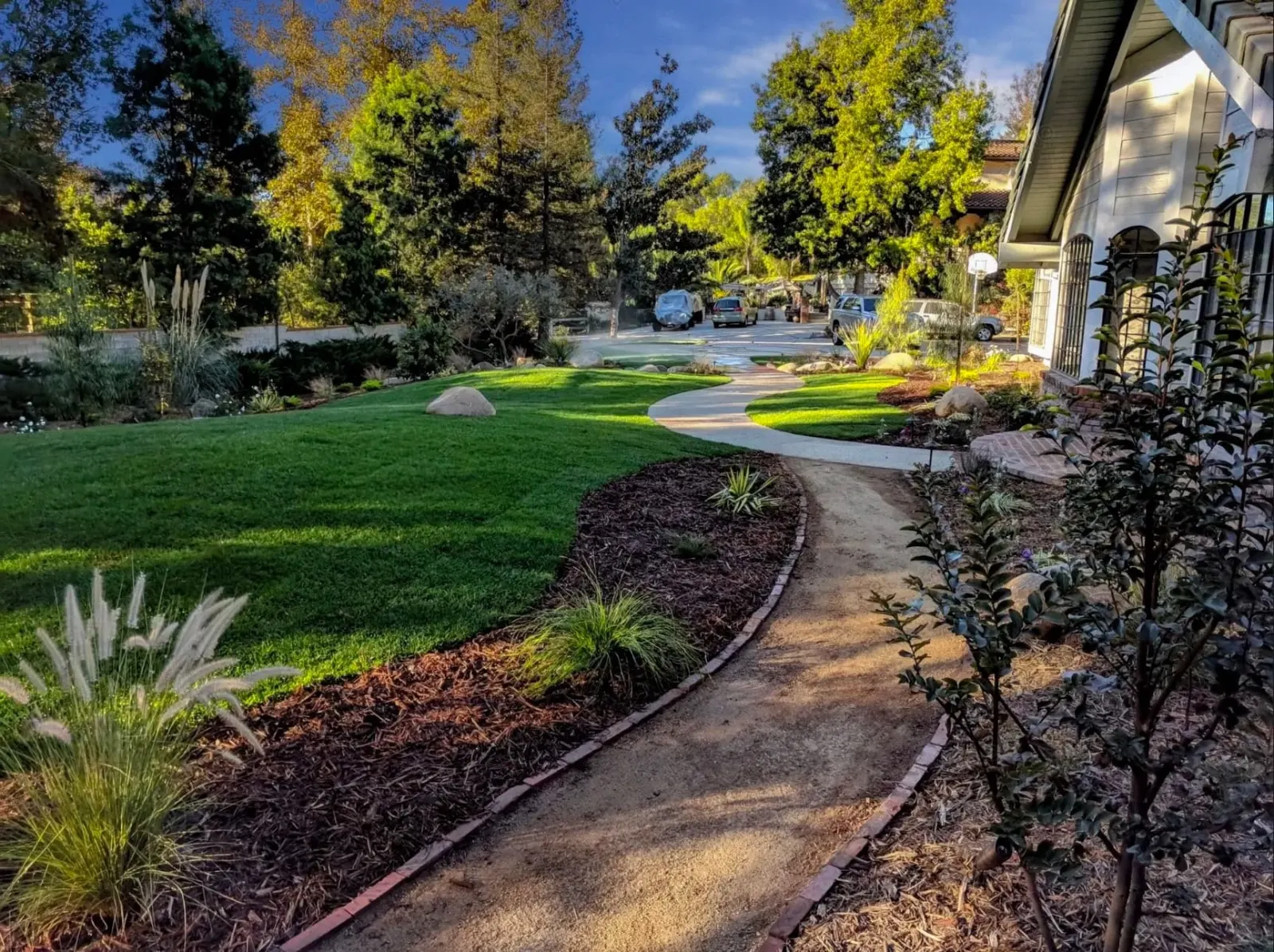
Fire-Resilient Landscape Design
A fire-resilience maintenance calendar
Everything built on the rest of this site stops working within two seasons if nobody clears it.
Fire-resilient landscape design produces a condition that has to be maintained, not an object that stays finished. A property treated once and left alone is back to a continuous fuel bed within about two growing seasons, and this is the single most common reason a well-built landscape stops protecting anything.
Late winter and early spring
Late winter and early spring is when growth starts and when the rest of the year is decided. Structural pruning, limbing up trees to break the ladder from ground fuel to canopy, removing anything that died over winter, and repairing the irrigation faults that only show themselves when the system runs again. It is also the right time to reset controller schedules for the season ahead rather than in July when everything is already stressed.
Late spring into early summer
Late spring into early summer is when annual grasses cure and turn to fine fuel, which is the fastest-igniting material on most properties. Cutting and clearing them before they are fully dry, keeping the first five feet clear, and getting roof and gutter clearing done are the work of this window. In much of our service area this is also when local clearance deadlines and inspections fall, so it is worth knowing your own date rather than a general one.
Through peak season
Through peak fire season the work is small, frequent and unglamorous: clear leaf litter out of gravel and off hard surfaces, keep dead material out of shrubs, keep the area under decks and against walls empty, and watch that irrigation is actually reaching the zone nearest the house. Nothing here is a project. All of it is the difference between a designed condition and a photograph of one.
After the first rains
After the first rains growth returns, and erosion problems on a slope declare themselves. It is the window for planting, for repairing any bare ground before winter opens it up, and for the heavier work that is unwise during fire season.
Questions people actually ask
How much maintenance does a fire-resilient landscape need?
More attention than a conventional garden in the first five feet and on hard surfaces, and often less elsewhere, because correctly spaced and correctly chosen planting needs less intervention. The work is frequent and small rather than occasional and large.
Do you maintain the landscapes you build?
Talk to us about it for your property. The important point is that the plan should be maintainable by whoever is going to maintain it, and a design that only works with a crew nobody has hired is a design that has failed.
What is the one thing to do if I only do one thing?
Keep the first five feet around the structure clear of anything that will burn, and keep it clear, including the leaf litter that lands in it every week. It is the smallest area and the highest value.
Sources
Sources: CAL FIRE, Defensible Space, Ventura County Fire Department. Requirements change and vary by address. Confirm yours with your local fire authority before relying on anything here.
The rest of the guide
Fire-resilient landscape design, one question per page.
- Fire-Resilient Landscape Design: the complete guideThe hub page: what it is, the zones, and what it changes on a property.
- Zone 0: the first five feetThe smallest zone, the one that costs a garden the most, and the one nearly everybody gets wrong.
- Plant selection and spacingThere is no fireproof plant. There are plants that are badly placed, badly spaced and badly maintained, and those are the ones that carry fire.
- Hardscape as a firebreakA path is not automatically a firebreak. Width, continuity and what sits either side of it decide whether it does anything at all.
- Irrigation and fuel moistureThe moisture in a living plant in September is a design outcome, decided by a controller somebody set in July.
- Slopes and hillside lotsA house above a slope has a different problem from a house on flat ground, and the same clearance distance does not mean the same thing.
- Insurance and HOA inspectionsWe can build a landscape that meets what an inspection asks for. We cannot promise you a policy, and anybody who does is not in a position to.
- Rebuilding after a fireThe ground is not the ground it was. Putting the old garden back on it is how the second problem starts.
- Cost and sequencingAlmost nobody does the whole property in one go. The order you do it in changes how much protection you have bought at every point along the way.
- Rebuilding in Malibu and the canyonsWhat the ground needs before anything is planted, and why the garden is the last stage rather than the first.
- Where this falls shortThis is the page most companies in our position do not write. It is here because the alternative is letting somebody believe a garden will save a house.
Tell us about the property
Send a few lines about what you have and what you want. We will tell you what we think it takes, what order it should happen in, and whether we are the right company for it.